listicle
Where Can Spanish Speakers Find Financial Literacy Resources?

Last Updated: October 25, 2026
Quick Summary
Spanish speakers can find financial literacy resources through government consumer agencies, nonprofit education groups, and public library systems, most of them free. Trustworthy options include the CFPB's Spanish-language tools, the Hispanic Federation's workshops, and MyMoney.gov. Check that content is written in Spanish rather than machine-translated, and never share bank credentials with a free resource.
- Most trustworthy Spanish-language financial education is free and comes in four formats: worksheets, online courses, in-person workshops, and live virtual sessions.
- Legitimate educators never need your bank credentials to teach you how to budget, so close any resource that asks.
- Search your library's events page for finanzas or educación financiera rather than financial literacy to find Spanish workshops.
- The CFPB's Money as You Grow Bookshelf pairs children's books with parent guides in its Spanish-language collection.
- Many in-person workshops run as a series of four to six weekly sessions, which builds more than a one-off class.
Table of Contents
- What Makes a Spanish-Language Financial Resource Worth Using
- Free Financial Literacy Resources in Spanish
- Spanish-Language Financial Education Courses
- Financial Literacy Workshops in Spanish
- Teaching Children About Money Management in Spanish
- How to Spot a Scam While Searching for Financial Help
- How to Choose the Right Resource for Your Situation
- Build Your Blueprint with Bilingual Financial Education
- Frequently Asked Questions
What Makes a Spanish-Language Financial Resource Worth Using
A Spanish-language financial resource is worth using when it was written for Spanish-speaking households from the ground up, not run through a translation tool.
At Financial literacy, we built our bilingual platform of financial literacy resources around a simple observation: people disengage from financial education when it feels like a sales funnel or a test they can fail.
Most resource lists hand you a pile of links with no way to tell which are current, which are actually in Spanish, and which serve your situation.
Language Quality: Translation vs. Culturally Written Content
Culturally written financial content is developed in Spanish by people who understand how Latino and Hispanic households actually talk about money, debt, and family obligations.
How do you tell the difference in about two minutes?
- Read the first paragraph out loud. If it sounds like a manual, it is one.
- Check whether the resource uses everyday words for debt and savings, or textbook vocabulary.
- Look for family and household examples. Culturally written material tends to include them.
Dialect matters too: a resource written for Mexican-American readers in Texas may use different vocabulary than one built for Caribbean or South American audiences. Neither is wrong, but note it before committing time to a course.
Cost, Format, and Access at a Glance
Most trustworthy Spanish-language financial education is free, in four formats: self-paced online courses, printable worksheets, in-person workshops, and live virtual sessions. The table below summarizes what each is good for.
| Format | Typical Cost | Time Commitment | Best For |
|---|---|---|---|
| Printable worksheets | Free | 15-30 min per sheet | Building a budget this week |
| Self-paced online courses | Free to low-cost | 1-3 hours total | Learning at your own pace |
| In-person workshops | Usually free | 1-2 hours per session | Hands-on help and questions |
| Live virtual workshops | Usually free | 1-2 hours per session | People without local options |
One practical rule: if a "free" resource demands your bank credentials before showing you any content, close the tab. Legitimate educators do not need account access to teach you how to budget.
Free Financial Literacy Resources in Spanish
| Resource | Who it serves | Format | Cost | Spanish quality note |
|---|---|---|---|---|
| Consumer Financial Protection Bureau's Spanish-language resources | General consumers and service providers | Web tools, printable guides, parent guides | Free | Consumer-facing pages are published in Spanish, not machine-translated; terminology is plain and consistent |
| Office of the Comptroller of the Currency's financial literacy directory | Adults, educators, community organizations | Directory of programs and materials | Free | Spanish availability varies by listing, check each entry before committing |
| Washington OSPI directory of financial education resources for adults | Adult learners and instructors | PDF directory | Free | Points to Spanish-language entries but is a directory, not a course, expect clicking |
| Hispanic Federation | Latino families and community members | Interactive resources and workshops | Free | Culturally written for Latino households; workshop delivery in Spanish |
| Next Gen Personal Finance | Classroom teachers and independent learners | Curriculum directory with Spanish translations | Free | Built for classrooms; translation quality varies by unit, so preview a lesson first |
| MyMoney.gov | Parents, teachers, and kids | Activity guides and group lessons | Free | Federal consumer content; Spanish pages available for core topics |
A word of caution: free does not mean current. Government pages get archived and reorganized, and a link that worked last year may now land on a press release.
What most free-resource lists miss is eligibility. Some programs are open to anyone; others are limited to residents of a state, students in a specific district, or members of a partner organization. A resource you are not eligible for is not free, it is unavailable.
Finally, free resources are not a substitute for a sequence. A budgeting worksheet, a credit guide, and a retirement primer from three agencies will not add up to a plan unless you decide the order.
Spanish-Language Financial Education Courses
Self-paced courses suit people who want to learn on their own schedule.
For individual learners, the CFPB's Spanish tools cover budgeting fundamentals and pair well with the Money as You Grow Bookshelf, which combines children's books with parent guides.
What most course lists miss is the completion problem. Pick a course with short lessons and a worksheet after each one, because doing beats watching.
Financial Literacy Workshops in Spanish
Workshops beat courses for one reason: you can ask questions. In-person and virtual sessions in Spanish are offered by community organizations, nonprofits, library systems, and cooperative extension offices, and most are free.
Start with the three sources that actually list workshops by location:
- Public library systems. Many city and county libraries publish a calendar of free financial workshops, and larger systems offer Spanish-language sessions or bilingual facilitators. Search your library's events page for "finanzas" or "educación financiera" rather than "financial literacy."
- Cooperative extension offices. Land-grant universities run extension programs in most states that include consumer finance education, sometimes with Spanish-language materials and workshops. Search "[your state] extension financial literacy Spanish" to find the local office.
- Community development and nonprofit organizations. Local housing counseling agencies, credit unions, and Latino community organizations often host workshops that never appear in national lists. Ask at the reference desk or call 211 for local referrals.
For virtual options, national organizations are the most reliable starting point because their schedules are published online and open to people anywhere.
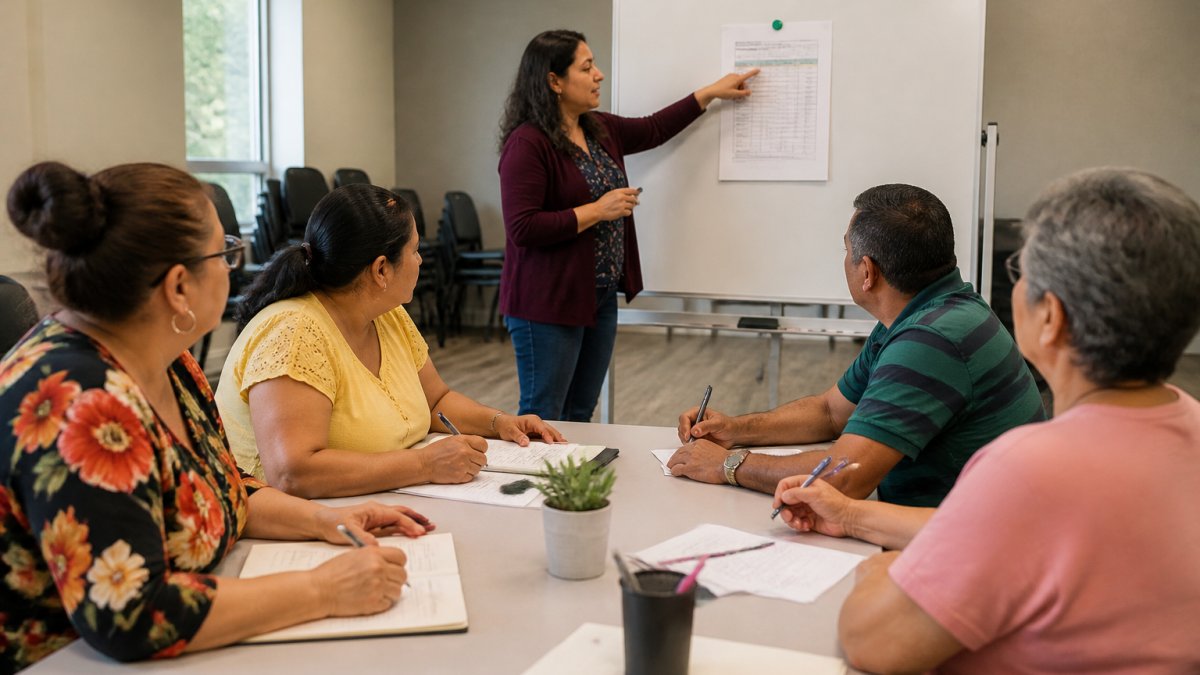
Before you attend, ask four questions: Is the session entirely in Spanish, or bilingual with translation? Is it live or recorded? Do you leave with a worksheet or action plan? And who is the named facilitator or organization behind it? A workshop that ends with a plan you can start that week is worth two hours.
Virtual workshops have widened access for people in rural areas or without transportation. If nothing local exists, search for virtual sessions hosted anywhere in the country, Spanish-language delivery does not depend on your zip code. The trade-off is losing in-person follow-up, so plan to email the facilitator your questions afterward.
One practical note on scheduling: many in-person workshops run as a series (four to six weekly sessions) rather than one-offs. A series is usually worth more because it builds, but it demands a bigger time commitment. Ask whether you can attend the first session before committing.
Teaching Children About Money Management in Spanish
Teaching children about money management works best when the lesson is in the language the family uses at home, and when it involves doing rather than listening.
MyMoney.gov offers teacher-oriented group activities that introduce children to identity theft and fraud, including ways kids can protect themselves.
For families who want something you can print and use tonight, you can explore the bilingual money activities for kids and start with whatever fits your child's age. If you prefer a single sheet to work through together, the save-spend-share family activity sheet gives you a jar plan, an allowance split, and a checklist to review as a family.
The mistake most parents make is waiting for a "money talk." Short, repeated conversations beat one big lecture every time.
How to Spot a Scam While Searching for Financial Help
Financial scams target people actively searching for help. The warning signs are consistent:
- Guaranteed returns. Nothing legitimate guarantees investment results.
- Upfront fees for a "free" program. Real free resources do not ask for payment to unlock content.
- Pressure to act today. Urgency is a sales tactic, not a service.
Watch out: a common scam involves fake "credit repair" services that charge monthly fees to dispute accurate information on your credit report. Disputing accurate items does not raise your score, and the fees add up while your credit stays the same.
If a resource asks you to wire money, buy gift cards, or share account credentials, stop. Consumer protection agencies publish current scam alerts, and checking one before you enroll costs five minutes.
How to Choose the Right Resource for Your Situation
Match the resource to your life stage and most urgent problem, not to whatever ranks first in a search. Use this checklist:
- Identify your top issue: everyday budgeting, credit, debt, or long-term planning
- Confirm the material is written in Spanish, not machine-translated
- Check the cost and whether an account or bank link is required
If you want a fast read on where you stand before choosing, a quiz can help. You can take the free financial wellness quiz and get a score plus suggested next steps, which narrows the field considerably.
Different situations call for different formats. Overwhelmed by debt? Start with a workshop where you can ask questions. Parent of young kids? Start with a printable activity. Nearing retirement and wary of linking accounts?
Build Your Blueprint with Bilingual Financial Education
Here is the challenge most people hit: knowing where the good resources are and actually changing your money habits are two different things. Scattered worksheets and one-off workshops rarely add up to a plan.
That gap is why we built Money Blueprint as a bilingual platform in English and Spanish. If you want printables to use offline, you can download the free financial worksheets with no email required, and if you are comparing options, you can review the plan options and pricing before deciding.
Get started with Financial literacy and turn a list of resources into a plan you can actually follow.
Frequently Asked Questions
Where can Spanish speakers find free financial literacy resources?
Start with public agencies and nonprofits. The Consumer Financial Protection Bureau publishes Spanish-language tools on budgeting and banking, and its Money as You Grow Bookshelf pairs children's books with parent guides. Next Gen Personal Finance offers free personal finance curriculum translated into Spanish, and the Washington OSPI maintains a free directory of adult financial education resources. The Hispanic Federation also provides interactive resources and workshops. Check each site's current page, since directories and archived posts get updated, and confirm which materials are actually in Spanish before you commit time to them.
Are there financial literacy workshops in Spanish near me?
Availability varies by location, so check two things before signing up: whether the workshop is in Spanish and whether it runs in person or online. The Hispanic Federation lists workshops covering budgeting, saving, investing, and credit, though the listing does not always confirm language or schedule. Community organizations and library systems often host sessions too. Virtual workshops widen your options considerably if local in-person classes are scarce. Ask the organizer directly which dialect the materials use and whether handouts are bilingual.
What should a Spanish-language financial education course cover?
A useful course starts with budgeting, saving, and spending, then moves into credit and credit cards, debt management, and the basics of investing and planning. The NFEC curriculum in Spanish also addresses money habits and your relationship with money, which matters if past behavior is the real obstacle. Look for lessons paired with quizzes and worksheets rather than video alone, since action is what changes habits. If you are comparing courses, check whether the Spanish is originally written or machine-translated, and whether the terminology matches how you actually speak about money.
How can families find Spanish-language resources for teaching children about money?
The CFPB's Money as You Grow Bookshelf is the clearest starting point: it pairs children's books with parent guides and sits among its Spanish-language resources. MyMoney.gov offers teacher-oriented group activities for children on identity theft and fraud awareness, though the listing does not confirm Spanish availability, so verify first. For everyday teaching, use real moments, like comparing prices at the store or splitting a weekly allowance into spending and saving jars, and use the same words in both languages so the concepts stick.
How do I know the Spanish financial advice I find is accurate?
Check who published it. Government agencies, established nonprofits, and educator councils carry more accountability than anonymous blogs or social media accounts. Then check the language itself: read a sample lesson and see whether it uses natural financial Spanish or reads like machine translation, which often mangles terms like credit, interest, and debt. The CFPB and OCC directories are vetted starting points. If a resource asks for bank login details or payment before showing any content, treat that as a warning sign and move on.
The resources exist. The harder part is picking one and finishing it. That is the work, and it is worth doing.

FAQ
Start with public agencies and nonprofits. The Consumer Financial Protection Bureau publishes Spanish-language tools on budgeting and banking, and its Money as You Grow Bookshelf pairs children's books with parent guides. Next Gen Personal Finance offers free personal finance curriculum translated into Spanish, and the Washington OSPI maintains a free directory of adult financial education resources. The Hispanic Federation also provides interactive resources and workshops. Check each site's current page, since directories and archived posts get updated, and confirm which materials are actually in Spanish before you commit time to them.
Availability varies by location, so check two things before signing up: whether the workshop is in Spanish and whether it runs in person or online. The Hispanic Federation lists workshops covering budgeting, saving, investing, and credit, though the listing does not always confirm language or schedule. Community organizations and library systems often host sessions too. Virtual workshops widen your options considerably if local in-person classes are scarce. Ask the organizer directly which dialect the materials use and whether handouts are bilingual.
A useful course starts with budgeting, saving, and spending, then moves into credit and credit cards, debt management, and the basics of investing and planning. The NFEC curriculum in Spanish also addresses money habits and your relationship with money, which matters if past behavior is the real obstacle. Look for lessons paired with quizzes and worksheets rather than video alone, since action is what changes habits. If you are comparing courses, check whether the Spanish is originally written or machine-translated, and whether the terminology matches how you actually speak about money.
The CFPB's Money as You Grow Bookshelf is the clearest starting point: it pairs children's books with parent guides and sits among its Spanish-language resources. MyMoney.gov offers teacher-oriented group activities for children on identity theft and fraud awareness, though the listing does not confirm Spanish availability, so verify first. For everyday teaching, use real moments, like comparing prices at the store or splitting a weekly allowance into spending and saving jars, and use the same words in both languages so the concepts stick.
Check who published it. Government agencies, established nonprofits, and educator councils carry more accountability than anonymous blogs or social media accounts. Then check the language itself: read a sample lesson and see whether it uses natural financial Spanish or reads like machine translation, which often mangles terms like credit, interest, and debt. The CFPB and OCC directories are vetted starting points. If a resource asks for bank login details or payment before showing any content, treat that as a warning sign and move on.